KARIBUwelcome
POLE POLEslowly
BAHARIthe sea
Three chapters. One island. Wander slowly.
A slow journey through Stone Town's carved doors, the grace of the dhow, and the rhythm that keeps the Swahili coast alive.
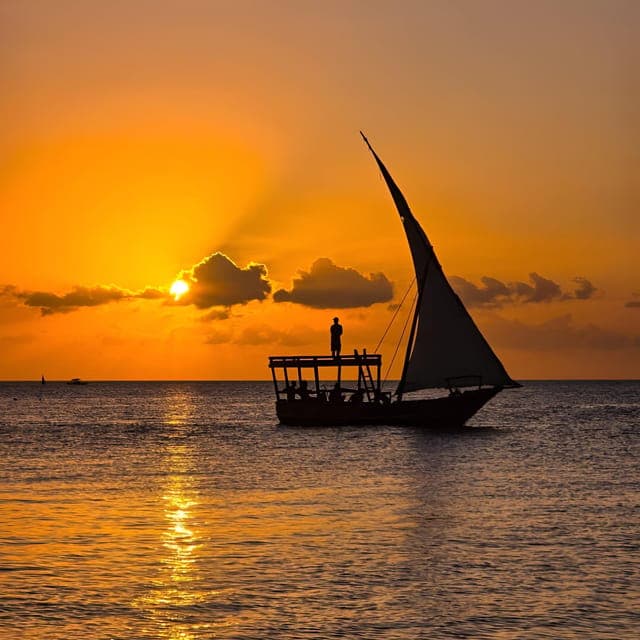
Golden hour
Nungwi, at dusk
The monsoon turns, and the horizon fills with sails.
Three chapters. One island. Wander slowly.
Stone Town is a labyrinth of coral-rag walls, carved teak doors and courtyards that still hold the scent of centuries.
Arab dhows, Indian merchants, Portuguese forts and Swahili families folded into one peninsula. Walk it slowly: every doorway is a signature, every alley a conversation between worlds.

Stone Town, at the edge of the old harbour.
01 / 03Cloves, cinnamon and cardamom once made these islands the most coveted coordinates in the Indian Ocean.
Brass studs, lotus motifs and arched frames — each door quietly tells you where its owner came from.
At dusk the seafront becomes a lantern-lit market of grilled seafood, sugarcane and salt air.
Out past the reef, the dhow keeps the horizon in balance — a geometry of wood, wind and patience.
The same lateen sail has crossed these waters for a thousand years. Today it carries fishermen at dawn and travellers at sunset, past sandbanks that appear and vanish with the tide.
A lateen sail off Nungwi, riding the monsoon.
02 / 03Swim through water so clear it borrows its colour from the sky, then stay for a sunset that lingers.
A ring of coral and turquoise where dolphins pass and the reef hums with small, bright life.
Every season, crews lean into the wind and race the old boats for the pure joy of it.
Swahili means “of the coast” — a language, a kitchen, a way of belonging that refuses to sit still.
It is taarab drifting from a courtyard, urojo ladled at midnight, drums answering drums in Makunduchi. Culture here is not on display; it is simply how the evening begins.

Drum patterns and lantern light, after the sun goes down.
03 / 03Arab strings, Indian harmonies and Swahili poetry, folded into one slow, glittering song.
The street-corner soup of Zanzibar: sharp, sweet, golden and impossible to explain in one spoon.
After the rains, the village dances the mwaka kogwa — a joyful, fire-lit reset of the year.
Three days is enough to fall for Zanzibar. A week is enough to understand why people keep returning — for the light, the water, and the unhurried rhythm of a place that has always known how to wait.
A perfect first day
Sample rhythmMorning · Stone Town
Walk the old quarter before the heat. Carved doors, the fort, a small cup of spiced coffee.
Midday · Spice farm
Cinnamon, vanilla and black pepper, then lunch beneath a mango tree that has seen it all.
Golden hour · Sandbank
Sail out as the light turns copper. Swim, drift, and let the tide decide when you go home.
Sunset is never rushed here